Using the Personal Network Profile
Last updated: August 19, 2025
Everyone who responds to an Organizational Network Survey in Teamspective gets access to their personal Network Profile.
Read on to learn what the profile means and how you can use it for your benefit.
What is the Network Profile?
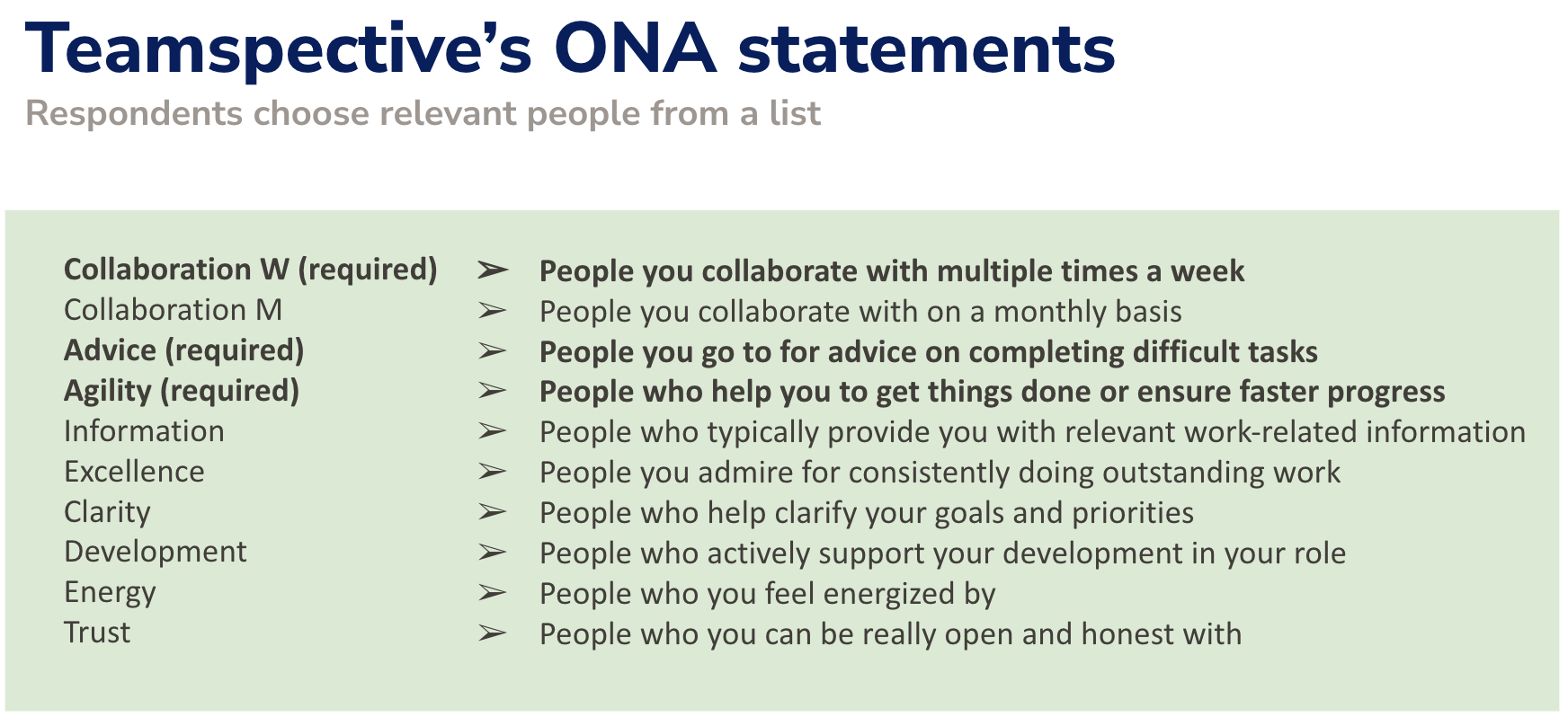
The network profile is an overview of your role and strengths as part of your organization's network. The results on the page are generated based on how other people around you have nominated you in the Organizational Network Survey. The survey consists of these 10 statements:
The profile is not an evaluation of your performance, and nobody scores high on all areas. In fact it's more normal to not have any high scoring results in the chart.
The main chart demonstrates your network strengths, as indicated by other people's survey responses. Each area in the chart is related to a statement in the survey (see more details later in this article). Teamspective calculates a percentile rank for each individual based on the survey responses.
With this chart you get an overview of what your strengths are in the network. If you are missing a score in the chart, it does not mean that you are bad in this area. It just means that you were not nominated by others. This might be for multiple reasons: your colleagues only nominated a few individuals or some of your colleagues did not respond to the survey at all.

Self-reflection:
Does the profile reflect who you are?
Are there some surprising findings in the profile?
Is there an area which you have already decided to develop in? Is this an existing strength?
Definitions of the Dimensions
Each dimension matches one statement from the survey. They show what kind of connections others primarily experience having with you. Below you’ll find a short explanation of each dimension:
Trust
How much people rely on you as a dependable colleague and safe person to share with. Trust reflects confidence in your intentions and follow-through.
Energy
How much positivity, motivation, or enthusiasm you bring to others. High energy means you help uplift people and keep momentum going.
Development
How much you support the growth and learning of others — for example, by mentoring, coaching, or creating opportunities for them to develop.
Clarity
How much you help others understand goals, priorities, or next steps. Colleagues may look to you for simplifying complexity or making things clearer.
Excellence
How much you raise standards and push for quality. This reflects your contribution to ensuring things are done well and with attention to detail.
Information
How much you are a source of knowledge, updates, or context that others need. You may be the “go-to” person for certain expertise or insights.
Agility
How much you help others progress in their work and adapt quickly. Agility reflects enabling movement and removing obstacles.
Advice
How much others come to you for your perspective, judgment, or guidance when making decisions.
Note: Each of these dimensions is measured by how often colleagues nominate you in these roles. Even a “lower” score means that several people already recognize you for this contribution.
Execution, Leadership and Culture
The Execution, Leadership and Culture categories combine multiple statements to indicate your overall level of connections in that category. These scores are percentile ranks, i.e. scoring 65 means you scored higher than 65% of the organization.
Execution
Advice - People you go to for advice on completing difficult tasks
Excellence - People you admire for consistently doing outstanding work
Leadership
Clarity - People who help clarify your goals and priorities
Agility - People who help you to get things done or ensure faster progress
Development - People who actively support your development in your role
Culture
Energy - People who you feel energized by
Trust - People who you can be open and honest with
Scale for each category:
Base level
Moderate
Elevated
High
Exceptional
Influence and Demand
The influence and demand scores are calculated by Teamspective based on a specific mix of ONA survey statements and algorithms.
These scores are relational, meaning that the highest-scoring individual in your organization has the top score and every other score is calculated in comparison to that individual.
Demand measures the level of the person's incoming pressure from others, especially related to getting work done.
📏 Scale: Base level - Moderate - Elevated - High - Exceptional
For example how many people:
seek for their advice,
help to progress their work,
give clarity on goals and priorities etc.
Influence measures the level of the person's outgoing influence on others.
📏 Scale: Base level - Moderate - Elevated - High - Exceptional
For example how many people
depend on them as sources of information,
expert advice,
energy, or
clarity on goals.
Most people score low to moderate in these indicators due to the data being relational. The algorithms give more weight on the nominations made by more central individuals, leading to few people scoring high. In a balanced situation high levels of influence and demand go hand in hand.
❗ Low level of influence, high level of demand: This can be a signal of having an overburdened role in the network. We suggest to reflect on how much (and why) you are needed by others, and how much control you have over your own time and priorities.
Network Tags
Your profile can also include network tags which highlight your role within specific teams if you are in the top percentiles. This gives some further insight and perspective in how you are positioned in the network and what your impact could be in regards to collaboration and connectivity.

Connector - (TEAM NAME):
This tag means that you are an internal connector within this team (or these teams if you have multiple tags).
Big amount of connections within the team goes through this individual
If a connector would leave this team, it would have a significant impact on the connectivity / collaboration between members of the team.
Leadership / Culture / Execution
This tag means that you are in the top percentiles of the organization for the specific area.
How Scores Are Calculated?
Scores are based on mentions in the survey.
First, your overall mentions are combined and weighted by how central individuals have mentioned you.
Overall scores are scaled from 1–10, with 10 matching the person with highest overall score in your organization.
In most views the scores are translated into percentiles. In other words, scoring 65 means you scored same or higher than 65% of the organization.
Please note: Even a “low” score means multiple people have nominated you — it’s still meaningful. Most employees are closer to 1 than 10, so don’t expect everyone to score “high.”'
Your survey responses
The table at the bottom of the page includes your own nominations in the most recent survey. It includes who you nominated and to which statements.
Self-reflection:
Should you seek for a certain kind of connection, for example someone who supports your development? Or someone you can trust?
Are you relying on only a few specific individuals, or do you have a wider list of collaborative relationships?
Do you have strong relationships? Ie people you nominated for multiple statements.
How long is the list? Is this a healthy amount of people? Too few? Too many?