Engagement survey best practices
Last updated: August 15, 2025
Teamspective works with various types of organizations, each of them with a unique culture. There's no one-way-fits-all recommendation we can offer to you, but there are many best practices we recommend you to consider.
We'll leave it to you to think what is your organization's culture like, to find the sweet spot between rules vs guidelines, team independence vs hands-on HR involvement, on-demand learning vs big group trainings etc. Our expert team is always available if you want to discuss these topics with an experienced HR professional.
Keeping response rates high
Response rate is important because a high enough level ensures good data quality, enabling smart future decisions and behaviour. 100% monthly response rate would be fantastic, but you can achieve good enough data quality with less. We suggest to optimize for 75 - 85 % of employees to answer each survey, or each month if you run pulse surveys.
Teamspective is constantly improving the surveys to help keep response rates high over time. The Slack / Teams integration helps make the responding as easy as it gets. Also weekly / bi-weekly cadence builds a routine or habit of responding.
However, based on our experience the companies who achieve a sustained high response rate are also doing certain supportive actions.
Below you can see examples of supportive actions which are being taken in the organizations with consistently high response rates. A combination of tools, education, communication and self-leadership is the winning recipe to using this people data for your advantage.
Supportive actions correlating with high response rate
0 - 25 % | 25% - 50% | 50% - 75% | Over 75% |
| In addition to previous actions:
| In addition to previous actions:
| In addition to previous actions:
|
You can use the actions above as a road map for implementing supportive actions. Start from the left and gradually make your way to the right to ensure you are not trying to make everything happen at once.
Communication best practices
Share with the whole organization that you have checked and discussed the survey results.
Highlight the positive developments and/or teams that do really well.
Communicate on what areas the HR or executive team will be looking to take action on.
This increases engagement and trust in the organization, sets an example for all teams to do the same, and keeps the response rates up.
Make sure people responsible of the results also check the results.
The executive team discussing the results in their meeting. Delivering an exec summary via the results export feature helps save time for identifying insights and facilitating discussion. If you struggle to fit this into exec team's agenda, you can suggest to limit the time for this discussion and focus on just 1-2 main findings.
Team leaders should go through the results with their team at least once per month. This correlates with response activity and you can usually guess from the team's response rates how regularly managers are discussing about the results.
Host theme specific company wide discussion events for people to participate and share their insights.
Add survey results to company reporting.
A survey KPI or theme can and should be linked to company goals and initiatives to measure whether you actually succeed in improving.
eNPS is a classic top-level KPI that companies follow, but we encourage to think which makes most sense for your organization and select 1-3 different metrics to follow.
Education & Training
Using survey results for continuous improvement is a skill which develops over time, and can be improved via education and training. Here are some best practices:
Do a presentation, lecture etc
Record the session to use it in orientation for new employees or as a reminder for more tenured ones.
Properly communicate 'the why' to motivate the employees take the desired actions. It's best to share why the company needs everyone's inputs, and also how the individual can expect to benefit.
Make available content that people can use on-demand.
This can be a wiki article, e-learning etc. Every Teamspective user has access to Teamspective's Knowledge Base, which contains many useful materials, guides and recommendations for understanding, discussing and taking action on survey results.
Organize a training for understanding survey results and taking action.
Especially effective if there's a wide gap in the skills to read and address the survey results.
This can be an open-for-anyone training or a faciliatated workshop for one team to help discuss issues creating tension.
Teamspective offers training workshops, if you are looking for external experts to create the content or host these trainings for you.
Continuous Improvement
The desired end-state is having employees, team leaders and management actively reviewing results, discussing about the arising issues and working together to come up with solutions. Those actions demonstrate that people data is actively being used to support continuous improvement at the workplace.
Members of each group are also the people that have the context and ability to find the best solutions to fix issues and tensions preventing effective work. This is important because 80-90% of problems are local, and thus should also be tackled locally in each team.
Here are some examples of activities which we have encountered when working with our customer organizations:
CEO reviews results and actions with executive team members regularly.
Managers review results in team meetings at least monthly.
Teams take actions based on the results and also track outcomes with the results.
Managers actively reflect on learnings and share them with peers.
Building these routines creates a positive, self-reinforcing cycle which supports the organization on all levels when trying to succeed in a constantly changing environment. Activities on the top level show example for activities on lower level. However, each activity reinforces and supports the others.
Implications of hierarchical vs flat org structure
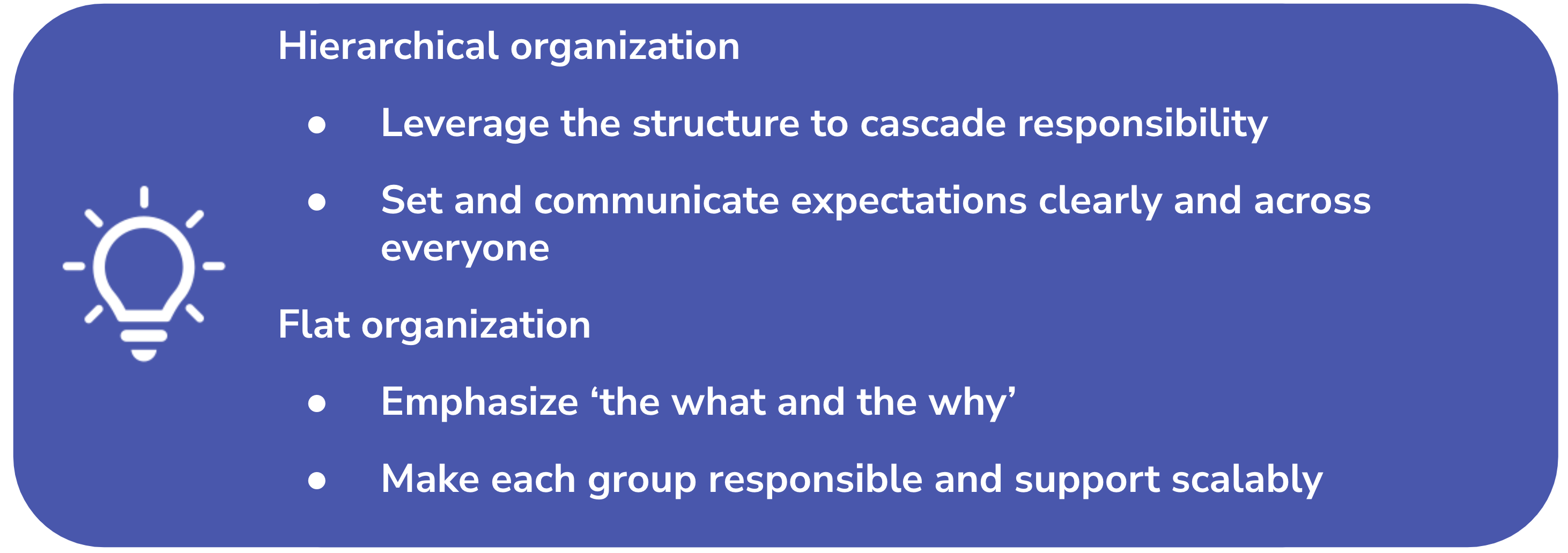
In tree-like, hierarchically structured organizations it should be fairly easy to assign every leader of a team, department, business unit etc. the responsibility of monitoring and improving their groups' wellbeing and effectiveness.
Challenge of this org type is that there is higher natural tendency to delegate responsibility to others if the expectations are not set clearly enough. Teams might expect their higher-ups to show example and remind when and how to process the results. Managers might expect their teams to act independently and reach out if any issues emerge.
So, set expectations and communicate them clearly. Make every team or group responsible of their results and actions and every manager responsible of leading by example and checking on their teams' progress.
In flat organizations where teams or groups may not have any official reporting lines the best ways of assigning responsibility and enforcing use of pulses is highly dependent on your culture.
If your teams are very independent and self-directing, you're probably very used to emphasizing 'the what and the why' whenever implementing anything new. That is our recommendation for pulses as well. Communicate the benefits for a team, show examples and as a cherry on top tell how everyone's input will also help the company as a whole to better understand what could be improved.
One benefit of flat structure is that there are no layers behind which teams could hide. It should be perfectly clear that each group working together is responsible of checking, discussing and taking action on their own results. Here it's especially important to set up scalable and on-demand support content, as there are no fixed owners for team development.